
I’ve specified, installed, and audited thousands of pneumatic exhaust points across OEM machinery and brownfield plants, and the same pain points always surface: harsh valve exhaust noise breaching OSHA limits, oil mist haze around workstations, and silencers that clog, shed fibers, or crack under vibration. When I need predictable noise attenuation, low backpressure, and a component that can live in real-world environments—washdowns, cutting fluids, temperature swings, and relentless cycling—I reach for sintered bronze silencers. They simply hold up, and they make my noise compliance and cleanliness metrics easier to hit.
Sintered bronze silencers reduce exhaust noise by 20–35 dB(A) in typical pneumatic valve applications while adding minimal backpressure, thanks to their rigid, interconnected porous structure. The bronze matrix filters particles and oil mist, resists corrosion/oxidation, manages heat effectively, and remains dimensionally stable under vibration. With proper selection (Cv, pore grade, size) and preventive maintenance (blowdowns, cleaning intervals), they deliver long service life and lower total cost of ownership versus fiber or foam silencers.
Below I break down what matters most to engineers and maintenance teams: filtration and durability advantages, realistic dB reduction on valves, how much oil mist capture you can expect, and a concise maintenance plan to keep mufflers performing for years.
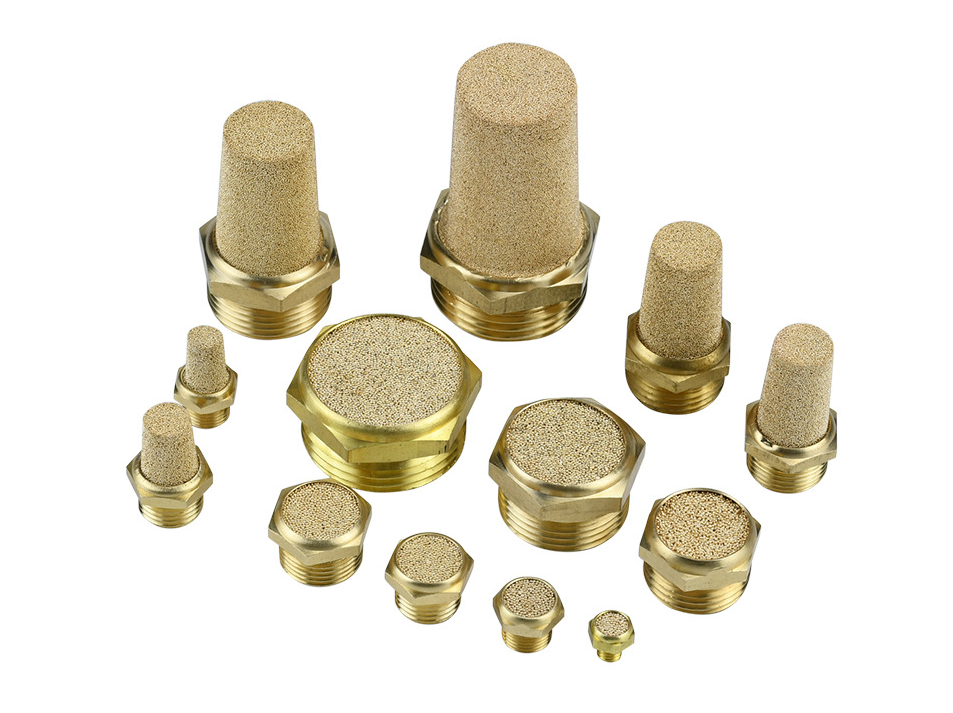
What advantages do sintered bronze mufflers offer in filtration, durability, and heat resistance for my system?
Why the porous metal architecture works
- Energy diffusion: Exhaust pulses are dispersed through a 3D network of controlled porosity, converting acoustic energy into micro-scale frictional heat—without the fragility of fibrous media.
- Low restrictions with repeatability: The interconnected pore network delivers consistent airflow and lower backpressure than most foam/fiber units at similar attenuation levels, which helps valves stroke properly and actuators hit speed targets.
Filtration performance and workplace cleanliness
- Intrinsic coalescing action: The porous matrix acts as a depth filter, intercepting particles and coalescing oil aerosols so droplets drain at the base of the silencer or remain captured in the media instead of atomizing into the workspace.
- Selectable pore grades: Typical porosity/filtration ranges are ~5–40 μm for general industrial exhausts; finer grades can be engineered when oil mist control is a priority (balanced against permissible backpressure).
Durability and environmental resistance
- Corrosion and oxidation resistance: Bronze stands up to moisture-laden exhaust, compressor carryover, and many industrial atmospheres better than carbon steel; it won’t swell, shed, or degrade like polymer foams.
- Mechanical strength and stability: Sintered construction resists vibration and pressure pulses; threads stay true, bodies don’t deform, and the rigid matrix won’t release fibers—ideal for sensitive production areas.
- Thermal management: Bronze’s thermal conductivity dissipates heat from rapid exhaust events, lowering local temperature spikes and reducing thermal stress on downstream components or adjacent elastomers.
At-a-glance comparison
| Attribute | Sintered Bronze Silencer | Fiber/Foam Silencer |
|---|---|---|
| Noise attenuation | High, stable over life | High initially, degrades as media collapses |
| Backpressure | Low to moderate, predictable | Often higher as media loads or swells |
| Filtration (particles/oil mist) | Good depth filtration, non-shedding | Good initially; may shed fibers, absorb oil |
| Durability (vibration/chemicals) | Excellent; corrosion/oxidation resistant | Fair; media fatigue and chemical attack common |
| Temperature tolerance | Broad; handles hot exhausts well | Limited by polymer softening/aging |
| Clean-room/sensitive use | Favorable (non-shedding) | Often unsuitable |
How much dB noise reduction can I realistically expect from sintered bronze on my valves?
Practical, conservative expectations
- Typical pneumatic valve exhausts: Expect 20–35 dB(A) reduction with a properly sized sintered bronze silencer. On smaller orifice valves and moderated duty cycles, 30–40 dB(A) is achievable; on large, high-flow dump valves, 15–25 dB(A) is more realistic unless you upsize the silencer.
- Why ranges vary: Attenuation depends on exhaust mass flow, pulse frequency, valve orifice, upstream pressure, and selected pore grade/Cv. Undersized silencers reduce noise less and add unnecessary backpressure.
Sizing for noise and performance
- Match Cv to the valve’s exhaust Cv so actuator timing isn’t compromised. As a rule of thumb, choose a silencer with effective flow capacity ≥ the valve’s exhaust port rating.
- If you’re chasing OSHA 85 dB(A) at operator position, measure baseline noise and select attenuation to close the gap with margin (5–10 dB). Combining sintered bronze with enclosure absorption or exhaust piping can yield compound benefits.
| Valve/Port Size | Baseline Exhaust Noise | Typical Sintered Bronze Result |
|---|---|---|
| M5–1/8 in mini valves | 90–98 dB(A) @ 1 m | 60–75 dB(A) (−25 to −35 dB) |
| 1/4–3/8 in valves | 95–105 dB(A) @ 1 m | 70–80 dB(A) (−20 to −30 dB) |
| 1/2–1 in high-flow | 100–112 dB(A) @ 1 m | 80–90 dB(A) (−15 to −25 dB) |
Note: Always verify with field measurements; environment and mounting affect readings.
Can sintered bronze help me minimize oil mist and particles in my workspace air?
Yes—provided you select appropriate porosity and maintain a healthy air prep chain. In my audits, swapping foam silencers for sintered bronze on valve exhausts typically drops local oil aerosol by a visible margin, especially where solenoid valves and actuators cycle rapidly.
How they reduce contamination
- Depth filtration and coalescence: The tortuous pore path captures fine particulates and coalesces micro-droplets into larger droplets that remain in or drain from the media rather than re-entraining into ambient air.
- Non-shedding construction: Unlike fiber mats, bronze won’t contribute shed particles, which is valuable near packaging lines, food/pharma equipment (with proper material compliance), and electronics assembly.
Make it work in your system
- Upstream control matters: Maintain FRLs—use adequately sized coalescing filters (0.01–0.1 μm) to intercept aerosols before they reach valves. Drier air means the silencer loads slower and remains effective longer.
- Choose pore grade by goal: For maximum mist reduction, select a finer-grade element on critical exhausts (pilot vents near operators), but ensure valve response isn’t degraded. Where speed is critical, use standard grades and address oil at the FRL.
Are there maintenance steps I should follow to extend my sintered bronze mufflers’ service life?
Absolutely. While these silencers are low-maintenance, a simple PM routine preserves attenuation, flow, and cleanliness.
Preventive maintenance checklist
- Visual inspections (monthly/quarterly): Look for oil darkening, chip accumulation, or impact damage. If a muffler appears “wet” or heavily discolored, plan a cleaning.
- Back-flush cleaning: Remove and blow back from outlet to inlet with clean, dry air at moderate pressure (e.g., 2–4 bar / 30–60 psi) to clear embedded debris. For heavy oil, soak in a compatible solvent (e.g., mineral spirits or isopropyl alcohol), ultrasonicate if available, then dry thoroughly and re-blow.
- Re-torque and sealing: Reinstall with thread sealant or PTFE tape as specified; avoid over-torque that can crack housings or distort threads.
- Don’t wash down hot: Allow cool-down before cleaning; thermal shock can stress the matrix.
- Replacement triggers: If pressure drop increases >20% from baseline, actuator timing slows, or noise rises noticeably, replace. In high-oil environments, consider scheduled rotation rather than reactive maintenance.
Selection tips that reduce maintenance burden
- Size up when in doubt: A larger body with higher Cv reduces loading rate and improves attenuation without choking the exhaust.
- Use guards in dirty zones: Add deflectors or locate exhausts away from direct chip/coolant spray to slow fouling.
- Standard threads ease PM: Most sintered bronze silencers are compact with NPT, BSPP, or metric threads—keep spares by thread size for fast swaps.

Conclusion
When I need a silencer that cuts noise reliably, filters out oil mist and particulates, and shrugs off vibration, heat, and corrosive shop atmospheres, sintered bronze is my default. Expect a realistic 20–35 dB(A) reduction on typical valve exhausts, low and predictable backpressure, and a non-shedding medium that keeps workspace air cleaner. With smart sizing (match Cv and pore grade to the valve and duty) and simple periodic cleaning, these mufflers deliver long service life and a lower total cost of ownership than disposable foam options—without compromising actuator performance.
Further Reading (External Resources)
- Engineering Toolbox: Sound Pressure and Decibels
- ISO 4414: Pneumatic fluid power — General rules and safety requirements
- Festo: Silencers and check silencers selection guide
- SMC: Silencers/Exhaust Cleaners Technical Data
- Parker Hannifin: Filtration and air preparation resources